Not every project fits into a headline role. Some were experiments, collaborations, or personal missions that shaped how I think about design today.
Each taught me something different about clarity, empathy, and making things people genuinely want to use.





Over the years, I’ve taken on roles that go beyond product design, coordinating mentorship programs, supporting youth communities, and documenting my own journey into tech. These projects shaped how I design, lead, and show up for others.

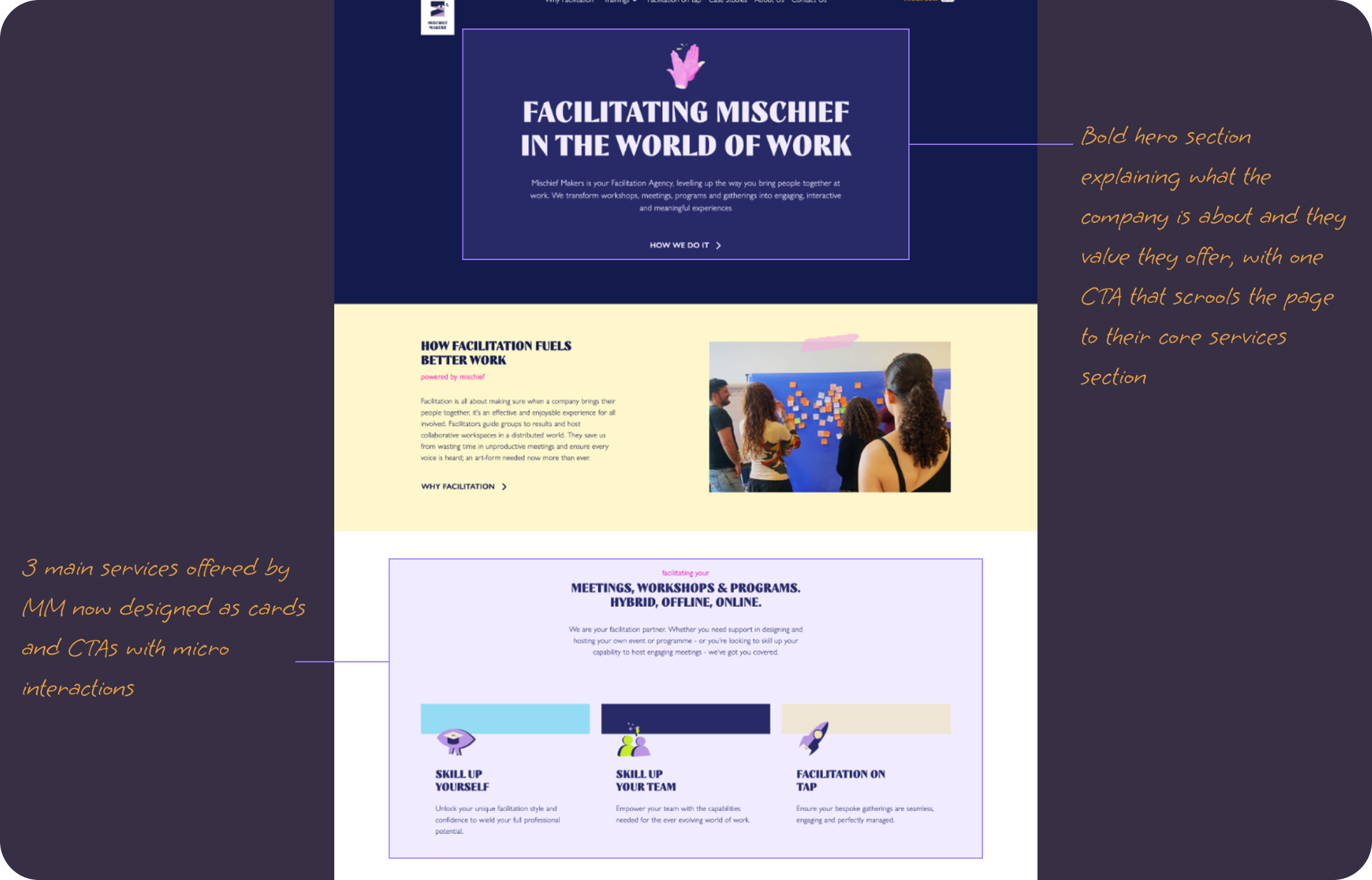
Mischief Makers needed a more intuitive website to reduce bounce rates and help users understand their workshops and facilitation programs.
The original site had unclear hierarchy, inconsistent navigation, and a high bounce rate of 66.45%, with an average session duration of just 1.34 minutes.
Users simply weren’t finding what they came for, or converting.
I redesigned their site using foundational UX methods:
The redesign led to measurable improvements across key metrics:
More importantly, this project taught me the foundation of my design philosophy: When information is clear, user intent becomes effortless, and everything else falls into place.
Many young people in Stockholm, especially those under 25 from under-resourced or under-represented backgrounds, struggle to access networks, industry exposure, and trusted guidance in the creative industry.
Routes In in partnership with Soho House created the Soho Mentorship Program to bridge this gap by pairing high-potential youth with experienced mentors across creative and professional fields.
As City Coordinator for the Stockholm program, I helped turn the mentorship initiative into a structured, supportive experience for both mentors and mentees.
My work involved a mix of community design, facilitation, and program ops:
Over each cohort, the program became more than mentorship, it became a community of encouragement, vulnerability, and possibility. Mentees developed clearer goals, stronger confidence, and meaningful personal connections. Mentors often stayed involved beyond the program, thanks to the strength of the relationships formed.
My biggest takeaway was that designing experiences doesn’t always involve screens, sometimes it means designing the environment, structure, and emotional safety that helps people grow.
.webp)
When I moved to Sweden to study design, everything felt new, the culture, the collaboration style, the learning methods, even the silence between conversations. Writing became my way to process it all: the uncertainty, the breakthroughs, the failures, the identity shifts, and what it means to rebuild your creative life in a new country.
On Medium, I began documenting my journey through Hyper Island and early design projects, not as polished case studies, but as raw reflections on learning, belonging, and growth.
My articles explore themes like:
These stories became a record of how I shaped my identity, not just as a designer, but as a Nigerian immigrant learning to navigate Sweden’s creative industry.
The writing helped me reflect, stay grounded, and see my own growth more clearly.
It resonated with other immigrants and early designers who saw themselves in the uncertainty, curiosity, and small wins.
Most importantly, it helped me understand the kind of designer I wanted to become: one who leads with empathy, humility, and clarity.
.png)
.svg)


.png)
.png)
.png)